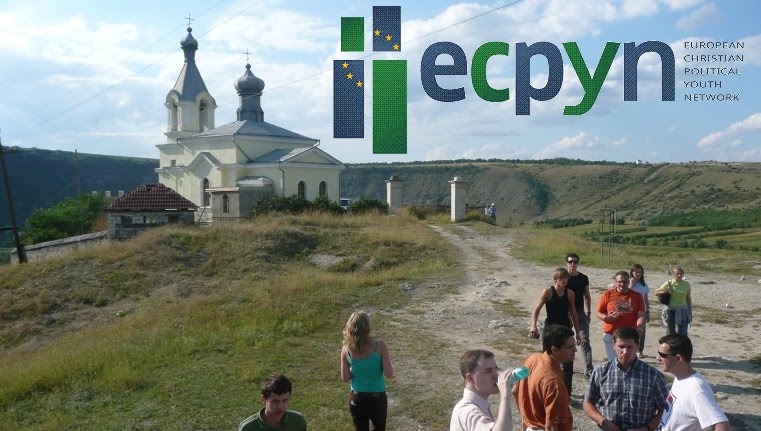
On Friday we started with a lecture by Attila Kiss, assistent professor at the 'Partium Christian University' in Oradea (Romania). Kiss discussed the historic development of the concepts of statehood and nationhood and how this influenced the situation of minorities in the Carpathian basin in general and in Transylvania especially.
After a short break the plenary was addressed by Vladimir Gjorcev MP (VMRO-DPMNE), chairman of the Committee on Defence and Security, who spoke to the theme of the summer school.
Before lunch a debating course was held. What was learned could of course immediately be applied, not only during the course and over lunch, but also in the afternoon. In the afternoon the group was divided into four. Each group was challenged to design a symbol to represent reconciliation. After some hasty discussions and drawings, each group came up with quite different designs.
The seats in the plenary room had now been arranged like in the House of Commons and two parties had to defend their own design against each other and attack the design of the group facing them. Thus two finalists were decided upon by a jury, consisting of Aleksander Ogorodnikov, Attilla Kiss and Vladimir Plamadeala. The two groups that were selected by the jury stood out on presentation and debating skills respectively. After a fierce final debate the public decided by one vote which design had won.
After some cooling down - in the case of many by having a swim in the beautiful nearby lake - Friday evening concluded the summer school with a closing dinner. During the dinner many speeches were given, each national delegation represented itself by singing a song and/or dancing a dance and at the end all the participants received a certificate for their participation in and contribution to the summer school. After this the party went on for a while of course :-)
Saturday morning, after breakfast, most of the participants checked out of the hotel and gathered in front of the loby to say goodbye to each other. Many left by bus for Skopje and from their on to their respective countries, some others went to Tessaloniki with another bus, to spend some time in that other (Greek) part of the geographical area called Macedonia.
Showing posts with label summer school. Show all posts
Showing posts with label summer school. Show all posts
Tuesday, July 20, 2010

Friday, July 16, 2010
King Samoil, Icons and Saint Clement Ohridski
After the coffee break we had lectures by Guido van Beusekom (ECPM secretary) and Aleksander Ogorodnikov. We then had lunch. After lunch we went to see the old town of Ohrid and especially the citadel. This citadel helped the Macedonians to resist for example Ostro-Goth invasions. We visited five churches and a galery of antique icons. We walked to some pitoresque parts of the town to finally end up at the beach, where we had some drinks, before we went back to the hotel.
At the hotel we had some workshops, that were also given on Tuesday, before we went to dinner. After dinner the representatives of the member organisations gathered in the conference room for the congress. The annual (financial) report was adopted, slightly modified statutes were accepted and Auke Minnema and Denys Dhiver were elected into the board after I had been thanked for my services over the last four years. After this it was time to relax a bit on the terace and notice that the WiFi wasn't exactly working again. When it started working again, it was time to write a blog :-)
At the hotel we had some workshops, that were also given on Tuesday, before we went to dinner. After dinner the representatives of the member organisations gathered in the conference room for the congress. The annual (financial) report was adopted, slightly modified statutes were accepted and Auke Minnema and Denys Dhiver were elected into the board after I had been thanked for my services over the last four years. After this it was time to relax a bit on the terace and notice that the WiFi wasn't exactly working again. When it started working again, it was time to write a blog :-)
Thursday, July 15, 2010
Protection of Ethnic Minority Rights in Macedonia
Early this morning the board convened to have a board meeting over breakfast and discuss some last issues in preparation for the congress (general assembly).
At nine the participants gathered in the conference room to listen to Ilija Dimovski, who is among other things a Member of Parliament of Macedonia for the VMRO-DPMNE, a center-right party of Christian-democratic orientation. Dimovski explained how the Macedonian system secures the rights of minorities. An important instrument in this is the fact that in order to change some basic laws parliament needs to reach a qualified majority. This means that an absolute majority is not enough, but half of the members of parliament representing the minorities should also agree in order to reach this qualified majority. Besides this formal requirement there are also some informal political customs aimed at reaching consensus and including minority parties, especially the parties representing the large Albanian minority.
The lecture was received very well, because of its informative content. Afterward some questions were raised and comparisons were made with other countries. It was concluded that some countries could take an example in the Macedonian approach.
And then there was coffee..
At nine the participants gathered in the conference room to listen to Ilija Dimovski, who is among other things a Member of Parliament of Macedonia for the VMRO-DPMNE, a center-right party of Christian-democratic orientation. Dimovski explained how the Macedonian system secures the rights of minorities. An important instrument in this is the fact that in order to change some basic laws parliament needs to reach a qualified majority. This means that an absolute majority is not enough, but half of the members of parliament representing the minorities should also agree in order to reach this qualified majority. Besides this formal requirement there are also some informal political customs aimed at reaching consensus and including minority parties, especially the parties representing the large Albanian minority.
The lecture was received very well, because of its informative content. Afterward some questions were raised and comparisons were made with other countries. It was concluded that some countries could take an example in the Macedonian approach.
And then there was coffee..
Economic integration / Excursion
On Tuesday afternoon there was a second round of workshops, including 'debating', 'ethnic minorities in the Carpathian basin' and 'Communication and Conflict Management'.
In the evening prof. dr. Florin Duma, economist at the University of Cluj (Romania) gave a lecture on the title 'The Economic Integration of Romania in the EU: Opportunities and Challenges'. In his lecture he gave a balanced perspective on this topic, equally discussing both sides and fairly mentioning possible downsides and risks to (fast or unprepared) economic integration into the European Union. He also gave some advice to countries hoping to join the EU in the future, to start preparing already, in order to be able to integrate economically in a way that benefits their country.
After the lecture there was a nice dinner. After that there was time to relax. Some people went for a boat trip, others visited the old town of Ohrid or went for a swim.
Wednesday morning we gathered at nine to go on an excursion by bus. After quite a long drive, which provided time for a lot of discussions and jokes among the participants, we arrived in Bitola. We first visited the historic museum. There was an exposition on the history of Macedonia from the time of Alexander the Great, the Roman occupation and Christianisation and also of the Macedonian revolution against the Otoman Turks. There was also an exposition on Mustafa Kemal 'Atatürk', the founder of Turkish secularism (aka Kemalism), who lived in Bitola at some point. After walking through the centre of Bitola and having coffee at a café, we took the bus to an archeological site, where several layers of urban settlement had been excavated. We could see, among other things, a Roman theatre and a beautiful mosaic in a Christian church, which included a lot of symbolism. Christians were represented by deers (inspired by the Psalm 'As the deer pants for water..') and the Romans were represented by a leopard attacking a deer et cetera.
From the archeological site near Bitola we went on to Krushevo. We visited the monument for the resistance fighters, where Viktor Mitevski gave some explaination on the Macedonian struggle for independence from domination by the consequent multinational countries, the Ottoman empire and the 'Kingdom of Serbs, Croats and Slovenes. We then had a look at the inside of the memorial, which hosted an exposition on the topic. From the monument we went on to the old town of Krushevo, where we visited an orthodox church with beautiful icons and fresco's.
When we arrived back at the hotel in Ohrid, we had dinner, after which we went to down town Ohrid, where we embarked on a boat, to make a tour of the lake and have a look at the monasteries, the chateau and villas on the side of the like. It was a nice tour and the lights in the dark added to the ambiance, which resulted in a good atmosphere for informal conversation and getting to know each other better. We continued this, when we disembarked and on to a café for some drinks and a bit of dancing (even though some were to shy to dance ;-) ).
When we got back to the hotel many went to bed, but others such as me started their computers...
In the evening prof. dr. Florin Duma, economist at the University of Cluj (Romania) gave a lecture on the title 'The Economic Integration of Romania in the EU: Opportunities and Challenges'. In his lecture he gave a balanced perspective on this topic, equally discussing both sides and fairly mentioning possible downsides and risks to (fast or unprepared) economic integration into the European Union. He also gave some advice to countries hoping to join the EU in the future, to start preparing already, in order to be able to integrate economically in a way that benefits their country.
After the lecture there was a nice dinner. After that there was time to relax. Some people went for a boat trip, others visited the old town of Ohrid or went for a swim.
Wednesday morning we gathered at nine to go on an excursion by bus. After quite a long drive, which provided time for a lot of discussions and jokes among the participants, we arrived in Bitola. We first visited the historic museum. There was an exposition on the history of Macedonia from the time of Alexander the Great, the Roman occupation and Christianisation and also of the Macedonian revolution against the Otoman Turks. There was also an exposition on Mustafa Kemal 'Atatürk', the founder of Turkish secularism (aka Kemalism), who lived in Bitola at some point. After walking through the centre of Bitola and having coffee at a café, we took the bus to an archeological site, where several layers of urban settlement had been excavated. We could see, among other things, a Roman theatre and a beautiful mosaic in a Christian church, which included a lot of symbolism. Christians were represented by deers (inspired by the Psalm 'As the deer pants for water..') and the Romans were represented by a leopard attacking a deer et cetera.
From the archeological site near Bitola we went on to Krushevo. We visited the monument for the resistance fighters, where Viktor Mitevski gave some explaination on the Macedonian struggle for independence from domination by the consequent multinational countries, the Ottoman empire and the 'Kingdom of Serbs, Croats and Slovenes. We then had a look at the inside of the memorial, which hosted an exposition on the topic. From the monument we went on to the old town of Krushevo, where we visited an orthodox church with beautiful icons and fresco's.
When we arrived back at the hotel in Ohrid, we had dinner, after which we went to down town Ohrid, where we embarked on a boat, to make a tour of the lake and have a look at the monasteries, the chateau and villas on the side of the like. It was a nice tour and the lights in the dark added to the ambiance, which resulted in a good atmosphere for informal conversation and getting to know each other better. We continued this, when we disembarked and on to a café for some drinks and a bit of dancing (even though some were to shy to dance ;-) ).
When we got back to the hotel many went to bed, but others such as me started their computers...
Tuesday, July 13, 2010
Repentance, justice and forgiveness as prerequisites to restoring relations
I was supposed to be flying from Amsterdam to Skopje by way of Budapest, but when I arrived at the gate in Budapest for the flight to Skopje, it turned out to be overbooked. This meant that I had to wait for some hours. After that I could fly to Zagreb (Croatia), I had to spend a few hours there again, which I used to visit the inner city. In the end I arrived in Skopje at quarter to twelve in the evening. It wasn't before three in the morning that I arrived in Ohrid, which explains why I haven't been able to give an update here until now. These problems in my travelling were frustrating, but the kind personnel, some compensation and the opportunity to visit Zagreb helped in reconciling myself with the fact I was going to be late ;-)
In my absence on Monday evening, the summer school was addressed by the Macedonian President of Parliament (Trajko Veljanovski) and the Minister of Defense (Zoran Konjanovski).
After a good local breakfast we started on Tuesday with a speech by the secretary general of the Department of Culture, who spoke about the importance of preserving Christian cultural heritage. After this Viktor Mitevski explained the political history and the workings of the current political system of Macedonia. Vladimir Plamadeala (Moldova) explained the situation regarding the so called frozen conflict over Transnistria (aka Pridnestrovje).
After a short coffee break on the terrace overlooking the Ohrid valley filled by a big lake bordering on Albania, we went on to four different workshops. Leo van Doesburg (ECPM representative in Eastern Europe) gave a workshop on 'Communication and Conflict Management', Jacques Bazen on 'Geopolitics', Krisztina Deme (Hungary) on 'Minority Problems in the Carpathian Basin' and the undersigned on 'The Christian Concept of Reconciliation'. In my workshop we indentified different types of conflict and several trajectories for reconciliation. We then applied this theoretical framework to existing conflicts. In conclusion we discussed the process of European integration as a kind of postponed reconciliation. In the sense that the founders of the European Community of Coal and Steel acted as if France and Germany were reconciled. In the long term reality would follow this imitation. The presentations will be published on the website after the summer school.
After a good warm lunch, part of the group went on a visit to the Monestary of Sv. Naum, who was a discipel of the Saints Cyrillus and Methodius and the others went for a swim or sightseeing in the town of Ohrid.
In my absence on Monday evening, the summer school was addressed by the Macedonian President of Parliament (Trajko Veljanovski) and the Minister of Defense (Zoran Konjanovski).
After a good local breakfast we started on Tuesday with a speech by the secretary general of the Department of Culture, who spoke about the importance of preserving Christian cultural heritage. After this Viktor Mitevski explained the political history and the workings of the current political system of Macedonia. Vladimir Plamadeala (Moldova) explained the situation regarding the so called frozen conflict over Transnistria (aka Pridnestrovje).
After a short coffee break on the terrace overlooking the Ohrid valley filled by a big lake bordering on Albania, we went on to four different workshops. Leo van Doesburg (ECPM representative in Eastern Europe) gave a workshop on 'Communication and Conflict Management', Jacques Bazen on 'Geopolitics', Krisztina Deme (Hungary) on 'Minority Problems in the Carpathian Basin' and the undersigned on 'The Christian Concept of Reconciliation'. In my workshop we indentified different types of conflict and several trajectories for reconciliation. We then applied this theoretical framework to existing conflicts. In conclusion we discussed the process of European integration as a kind of postponed reconciliation. In the sense that the founders of the European Community of Coal and Steel acted as if France and Germany were reconciled. In the long term reality would follow this imitation. The presentations will be published on the website after the summer school.
After a good warm lunch, part of the group went on a visit to the Monestary of Sv. Naum, who was a discipel of the Saints Cyrillus and Methodius and the others went for a swim or sightseeing in the town of Ohrid.
Saturday, July 10, 2010
Follow the progress of the summer school on our blogspot!
From Monday July 12 till Friday July 16, 2010, the 7th International Summer School will take place in Ohrid, Macedonia. The summer school is the core event of ECPYN. This year's theme will be 'Reconciliation'. Besides the ECPYN member congress, the conference will include lectures and workshops from senior politicians and other professionals from several countries and an excursion. You can follow the progress of the summer school semi-live on http://ecpyn.blogspot.com , because I will regularly publish short reports after sessions.
Saturday, August 15, 2009
European Council of Ministers of Foreign Affairs and Wrap-up of the Summer School
Friday morning a simulation game of the European Council of Ministers of Foreign Affairs tackled two cases: the secession of Scotland and its application for EU membership and a conflict between Estonia and Russia regarding the Russian minority in Estonia. After a lot of fierce negotiation it was decided that the Scottish secession was illegal and EU accession was undue as long as the 'United Kingdom of England and Northern Ireland' did not agree on Scottish secession and that the Estonian conflict should be resolved by repealing some laws discriminating against the Russian minority and at the same time fully supporting Estonia in its negotiations with Russia an the fight against hackers.
After the parliament game there was a panel discussion bringing together all the contributions of different speakers during the summer school and trying to find out what the common denominator was.
After this political working groups were started which were immediately joined by many of the participants of the summer school:
1. Church, State, Civil Society and the Public Domain (CSCSPD)
2. Human Dignity
3. Europe and co.
The working groups will write policy documents which can be used by ECPYN and set up projects. The day was concluded with both an oral, plenary and a written, individual evaluation of the summer school. The general feeling was that the week had gone by too fast, while it seemed at the same time more than a week, because so much was done.
After the parliament game there was a panel discussion bringing together all the contributions of different speakers during the summer school and trying to find out what the common denominator was.
After this political working groups were started which were immediately joined by many of the participants of the summer school:
1. Church, State, Civil Society and the Public Domain (CSCSPD)
2. Human Dignity
3. Europe and co.
The working groups will write policy documents which can be used by ECPYN and set up projects. The day was concluded with both an oral, plenary and a written, individual evaluation of the summer school. The general feeling was that the week had gone by too fast, while it seemed at the same time more than a week, because so much was done.
Congress adopts new statutes, resolutions and board
Thursday evening the member congress of ECPYN convened and after some small amendments decided to adopt the statutes. Besides the statutes, resolutions were adopted regarding the membership fee, the instigation of political working groups and the long term planning of the board.
Razvan Burleanu (Rumania) was elected as president of ECPYN and Nutsa Shavladze (Georgia) and Vladimir Plamadeala (Moldova) were elected to the board.
The cherry on the cake was a presentation by the chairman of the Christian Democratic Union of Youth (CDUY) of Ukraine. This organisation was admitted by the congress as observer member.
After the meeting of the congress the attendants toasted to the results with a well-deserved drink on a terrace nearby.
Razvan Burleanu (Rumania) was elected as president of ECPYN and Nutsa Shavladze (Georgia) and Vladimir Plamadeala (Moldova) were elected to the board.
The cherry on the cake was a presentation by the chairman of the Christian Democratic Union of Youth (CDUY) of Ukraine. This organisation was admitted by the congress as observer member.
After the meeting of the congress the attendants toasted to the results with a well-deserved drink on a terrace nearby.
Church and State, vertical and horizontal integration, Costs of the Balkan conflict
Thursday afternoon workshops were given by Leo van Doesburg and Jonathan van Tongeren. Leo spoke about vertical and horizontal integration in the European Union, how they should always go together, but also how far they should go.
Jonathan put forward the hypothesis that the battle between church and state has become an important part of European identity, since the balance in the marriage of those two was lost, which resulted in an ongoing violent divorce of church and state, in which the state keeps intimidating, abusing and violating the church. He argued hence that the separation of church and state may be a nice idea, but is does neither exist nor apply to concrete reality. He went on to argue that as Christians we should always be skeptical of abstract notions like separation of church and state, equality, free market, democracy et cetera. If such concepts are applied in an ideological way they can be very dangerous. Especially because there is no equally strong entity left in society to stand up against the state in case of violation of natural law, biblical norms or moral ethics in general.
After a break former minister of finance and now member of parliament of Albania, Arben Malai spoke to the congress about the costs of the Balkan conflict. He also discussed how long it would take for Balkan countries to catch up with Western Europe in an economic sense, concerning which he presented some staggering figures.
After dinner Henk Jan van Schothorst, political advisor of the SGP at the Netherlands Institute for Multiparty Democracy (NIMD) and former policy advisor to an MEP and coordinator Foreign Affairs for the, now defunct, European Political Group Independence/Democracy (IND/DEM), spoke about the reasons for starting European integration after the Second World War, the most important of which was obviously to have stability and peace. He then drew lines regarding stability and peace to our present time and the future.
Jonathan put forward the hypothesis that the battle between church and state has become an important part of European identity, since the balance in the marriage of those two was lost, which resulted in an ongoing violent divorce of church and state, in which the state keeps intimidating, abusing and violating the church. He argued hence that the separation of church and state may be a nice idea, but is does neither exist nor apply to concrete reality. He went on to argue that as Christians we should always be skeptical of abstract notions like separation of church and state, equality, free market, democracy et cetera. If such concepts are applied in an ideological way they can be very dangerous. Especially because there is no equally strong entity left in society to stand up against the state in case of violation of natural law, biblical norms or moral ethics in general.
After a break former minister of finance and now member of parliament of Albania, Arben Malai spoke to the congress about the costs of the Balkan conflict. He also discussed how long it would take for Balkan countries to catch up with Western Europe in an economic sense, concerning which he presented some staggering figures.
After dinner Henk Jan van Schothorst, political advisor of the SGP at the Netherlands Institute for Multiparty Democracy (NIMD) and former policy advisor to an MEP and coordinator Foreign Affairs for the, now defunct, European Political Group Independence/Democracy (IND/DEM), spoke about the reasons for starting European integration after the Second World War, the most important of which was obviously to have stability and peace. He then drew lines regarding stability and peace to our present time and the future.
Thursday, August 13, 2009
European identity, pipeline diplomacy, geo politics and young leaders
Today Leo van Doesburg gave a lecture about European identity and the European project, what it should be about and who should be included. His presentation was accompanied by provocative movie clips and made of bold statements and hard questions, which resulted in some fierce debate.
After a coffee break the group split up for two workshops, by Jacques Bazen (Netherlands) and Razvan Burleanu (Rumania) respectively. Jacques Bazen spoke about pipeline diplomacy and European energy policy, starting out by explaining the historical development of geo politics. Razvan Burleanu discussed the role of young Christian politicians and societal leaders and what can be opportunities for them especially in South East Europe.
After a well deserved lunch we went to see the Roman mosaics near Risan.
After a coffee break the group split up for two workshops, by Jacques Bazen (Netherlands) and Razvan Burleanu (Rumania) respectively. Jacques Bazen spoke about pipeline diplomacy and European energy policy, starting out by explaining the historical development of geo politics. Razvan Burleanu discussed the role of young Christian politicians and societal leaders and what can be opportunities for them especially in South East Europe.
After a well deserved lunch we went to see the Roman mosaics near Risan.
Excursion to Cetinje, Budva and Kotor
Today the participants of the summer school went on an excursion by touring car to the old royal capital of Montenegro, Cetinje, where they visited a museum about Montenegrin history and went sightseeing for some embassies and other prominent buildings. On the steep and winding road to Cetinje there were a lot of magnificent views of the mountains and bays.
From inland Cetinje the group went on to the old town of Budva down at the lagune. Historically Budva has not been part of Montenegro for some time, but was occupied consequently by the Venetians, who built a citadel which can still be seen there, and the Austro-Hungarians.
After Budva we visited Kotor with a lot of palazzo's and the castle of St. John on top of the mountain.
From inland Cetinje the group went on to the old town of Budva down at the lagune. Historically Budva has not been part of Montenegro for some time, but was occupied consequently by the Venetians, who built a citadel which can still be seen there, and the Austro-Hungarians.
After Budva we visited Kotor with a lot of palazzo's and the castle of St. John on top of the mountain.
Tuesday, August 11, 2009
How to have a European identity outside the EU
In the morning Vladimir Plamadeala, ECPM board member from Moldova, addressed the conference on the topic of 'How to have a European identity outside the EU'. To this end he first discussed what is Europe from several different perspectives. He talked about the geographical understanding of Europe as a continent, about nations who feel European or have European characteristics, but are geographically situated outside Europe and about Russia as a European or Eurasiatic country. He also mentioned the division of Europe into two civilizations, being western and eastern Christianity, as defined by Samuel Huntington in 'Clash of Civilizations'. He then went on to discuss what could be defined as European identity, using the results of several opinion polls and internet discussions and of course this led to a lot of discussion with the participants of the conference.
At the end of the afternoon the conference was addressed by Stieneke van der Graaf, who is an elected representative in the provincial legislature of Groningen (one of the 12 provinces of the Netherlands, with some 574.000 inhabitants). She talked about how she became involved in politics as a young person and soon became the youngest member of the legislature at 22 years of age. She also talked about what it means to be involved in politics as a young person and what she sees as her mission, to serve society. She went on to discuss her candidacy for the European Parliament and the campaign and how this was another new experience, especially becoming known to people all across the Netherlands.
When speaking about her work in the provincial legislature she also mentioned a recent success she had regarding the concept of 'family group conference'. At first there was some resistance to her motion, but in the end a majority supported it and in a few months it will be discussed how this can be legislated. It goes to prove, that even though caution is a good thing, politics does not always have to be a slow thing; things can be made to happen quickly if the political will is there.
At the end of the afternoon the conference was addressed by Stieneke van der Graaf, who is an elected representative in the provincial legislature of Groningen (one of the 12 provinces of the Netherlands, with some 574.000 inhabitants). She talked about how she became involved in politics as a young person and soon became the youngest member of the legislature at 22 years of age. She also talked about what it means to be involved in politics as a young person and what she sees as her mission, to serve society. She went on to discuss her candidacy for the European Parliament and the campaign and how this was another new experience, especially becoming known to people all across the Netherlands.
When speaking about her work in the provincial legislature she also mentioned a recent success she had regarding the concept of 'family group conference'. At first there was some resistance to her motion, but in the end a majority supported it and in a few months it will be discussed how this can be legislated. It goes to prove, that even though caution is a good thing, politics does not always have to be a slow thing; things can be made to happen quickly if the political will is there.
Europe between identity and integration
The Dutch-Czech Prof. dr. Hans Renner, historian at the Groningen University in the Netherlands, addressed the conference on the topic of 'Europe between identity and integration'. He started out by discussing the book 'The grand failure' by Zbigniew Brzezsinski and the grand failure of Zbigniew Brzezinski to go on to talk about two examples of supra-national identity (in the past), one of which was (and is) rather successful and one that was unsuccessful:
- the American identity and
- the attempt to create and identity of a new Soviet Socialist Man.
He went on to ask the question of whether there has ever been a common European identity, concluding that there has been a common Christian identity in Europe in the early Middle Ages.
At present there is, according to Renner, no identifiable European identity that is shared by a majority let alone all of Europeans. There are two components that can contribute to the evolution of a European identity: European enlargement and EU integration. He explained this by talking about the consequent enlargements of the EU and prospect enlargements, successes and disappointments of the enlargements of the EU.
His conclusion was that there has been a lot of enlargement, little integration and a non-existent or hardly existent European identity and that this identity can only come about when enlargement is accompanied by integration. This conclusion resulted in a lot of discussion.
- the American identity and
- the attempt to create and identity of a new Soviet Socialist Man.
He went on to ask the question of whether there has ever been a common European identity, concluding that there has been a common Christian identity in Europe in the early Middle Ages.
At present there is, according to Renner, no identifiable European identity that is shared by a majority let alone all of Europeans. There are two components that can contribute to the evolution of a European identity: European enlargement and EU integration. He explained this by talking about the consequent enlargements of the EU and prospect enlargements, successes and disappointments of the enlargements of the EU.
His conclusion was that there has been a lot of enlargement, little integration and a non-existent or hardly existent European identity and that this identity can only come about when enlargement is accompanied by integration. This conclusion resulted in a lot of discussion.
Preservation of Christian identity in the process of integration
This morning father Gojko Perovic, dean of the orthodox seminary of Montenegro addressed the summer school about the preservation of Christian identity of communities in the process of (European) integration.
He started by observing that Christians are citizens of another kingdom, of a city that is yet to come. He referred to the French revolutionary philosopher Rousseau, who, for this same reason, argued that Christians can not be dependable citizens for a secular state. He then went on to speak about the Jews that preserved their community's identity when in exile in Egypt and Babylonia, while at the same time being actively involved in politics. The Jews did not have their own political party to defend their interest, but still some managed to preserve their identity to a large extent. We would expect them to have been fully assimilated.
Later on many authoritative Jewish authors realized that the dominance of Hellenic culture posed a greater threat to the Jewish identity. For example even priests were attending the games of gladiators. When the Hellenic dominance became to obvious and Romans invaded Israel, the Macabees fought them with guerilla tactics.
So the Jews preserved their identity even though they did not have their own state, but they were actively involved in politics.
This could be a model for us Christians: to preserve the identity of our community, while being actively involved in politics, but not identitfying with any political system.
Father Perovic then spoke about the relation between church and state in Montenegro. The inheritance of communism is that people are afraid to integrate their beliefs into politics. The relation between church and state is not described, but the religious communities want to take the lead in changing this and the European Christian Political Movement (ECPM) has been instrumental in this.
He started by observing that Christians are citizens of another kingdom, of a city that is yet to come. He referred to the French revolutionary philosopher Rousseau, who, for this same reason, argued that Christians can not be dependable citizens for a secular state. He then went on to speak about the Jews that preserved their community's identity when in exile in Egypt and Babylonia, while at the same time being actively involved in politics. The Jews did not have their own political party to defend their interest, but still some managed to preserve their identity to a large extent. We would expect them to have been fully assimilated.
Later on many authoritative Jewish authors realized that the dominance of Hellenic culture posed a greater threat to the Jewish identity. For example even priests were attending the games of gladiators. When the Hellenic dominance became to obvious and Romans invaded Israel, the Macabees fought them with guerilla tactics.
So the Jews preserved their identity even though they did not have their own state, but they were actively involved in politics.
This could be a model for us Christians: to preserve the identity of our community, while being actively involved in politics, but not identitfying with any political system.
Father Perovic then spoke about the relation between church and state in Montenegro. The inheritance of communism is that people are afraid to integrate their beliefs into politics. The relation between church and state is not described, but the religious communities want to take the lead in changing this and the European Christian Political Movement (ECPM) has been instrumental in this.
Separation of politics and moral ethics
Yesterday at the International Summer School in Risan (Montenegro) Emil Krijestorac (Narodna Stranka, People's Party) spoke about how certain historical developments in (political) philosophy cause many current day politicians and others to believe that moral and politics have nothing to do with one another. He started out from Socrates and Plato and went on to speak about Nicholo Machiavelli's Il Principe (The Prince). He also told about those who did believe moral and politics go together and what's more should go together, among others the protestant theologian Max Weber.
Wednesday, September 24, 2008
Short report summer school now online
Today I posted a short report of the summer school on the website (http://www.ecpyn.org/). If you feel that something important is missing in the report, you can leave a comment here.
Sunday, August 31, 2008
Documents and presentations
Besides Auke's photos you can now also find some documents and presentations that were given at the summer school in Chisinau at http://www.ecpyn.org/ >> activities >> summer school 2008 >> downloads. If you have some other document or presentation to add, please e-mail it to me.
Soon there will also be a full report of the summer school on the website and of course you should keep track of it to see whether there are any new additions to the site. If you have some news feel free to post it here.
Cheerio!
Soon there will also be a full report of the summer school on the website and of course you should keep track of it to see whether there are any new additions to the site. If you have some news feel free to post it here.
Cheerio!
Pictures
It's a pleasure to be the first blogger on our new blog!
Hopefully, you all will join! I hope this will be a good way to share our political views, our news etc.
You can find my pictures of the summerschool on http://www.ecpyn.org/, >> Activities >> photos >> Chisinau 2008. Enjoy!
Hopefully, you all will join! I hope this will be a good way to share our political views, our news etc.
You can find my pictures of the summerschool on http://www.ecpyn.org/, >> Activities >> photos >> Chisinau 2008. Enjoy!
Subscribe to:
Posts (Atom)

 Posts
Posts

